
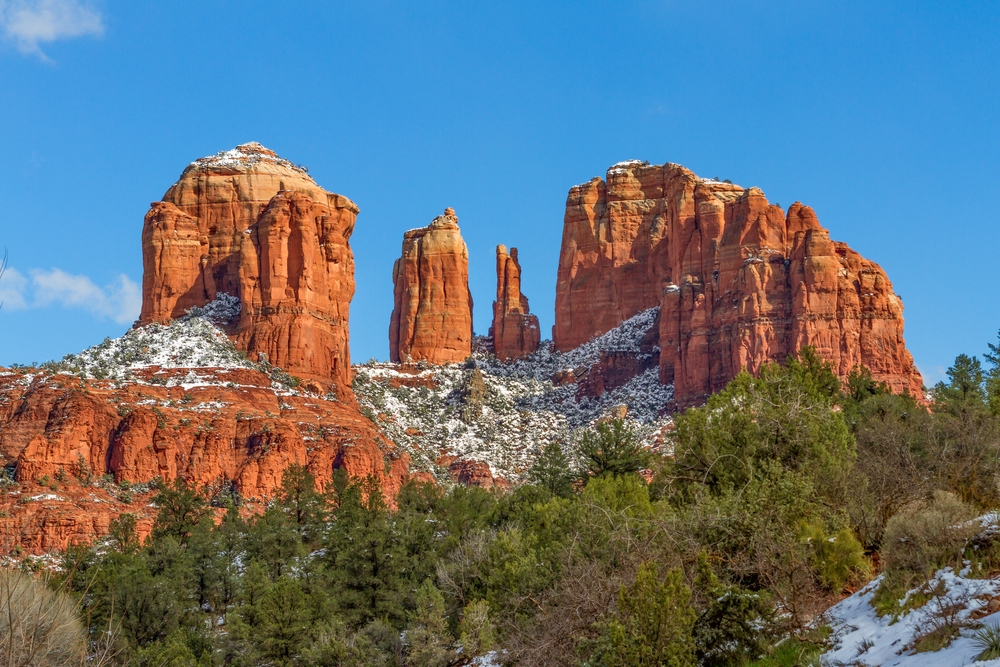
Cathedral Rock does not ease you in. It does not offer a gentle path through quiet forest or a wide-open vista from a parking lot. It stands across the landscape like a red stone cathedral, spires, buttresses, and all, and if you want what it has, you climb.
That is not a metaphor. The Cathedral Rock trail is a hands-and-feet scramble up slickrock that has humbled more than a few confident hikers. But the people who make it to the saddle between the spires, who sit down on that red stone shelf and look out across the Verde Valley with Oak Creek winding below, those people understand why this site has drawn human beings for thousands of years.
If you are looking for the Cathedral Rock vortex Sedona locals consider the most emotionally powerful of the four major energy sites, you have found the right guide. We have been living here since 1992, and in over three decades of sending visitors to this formation, one thing has stayed consistent: Cathedral Rock changes people. Not everyone can explain how. But they feel it.
Cathedral Rock and the People Who Came Before
Long before the word “vortex” entered anyone’s vocabulary, Cathedral Rock held meaning for the people who lived in its shadow.
The Yavapai-Apache Nation, whose traditional territory encompasses the entire Sedona region, regards the red rock formations as integral to their identity, places where the earth itself embodies creation and sustenance. Cathedral Rock occupies a particular place in this landscape. Some oral traditions associate it with the birthplace of the first man and first woman, a site where the boundary between the physical and spiritual worlds runs thin.
The Hopi and Navajo peoples also hold the red rock country in deep reverence. For the Hopi, the formations around Sedona connect to migration stories and ancestral pathways that crisscross the Southwest. The land remembers, even when the stories are not always shared publicly. We mention this not to claim knowledge of ceremonies or traditions that are not ours to share, but to establish something important: the spiritual weight you feel at Cathedral Rock is not a modern invention. It has been recognized for centuries by cultures whose connection to this ground runs far deeper than any visitor guide.
The Sinagua and Ancient Habitation
The Sinagua people, whose name, ironically, means “without water” in Spanish, thrived in the Sedona area from roughly 700 to 1400 AD. They built cliff dwellings, farmed along Oak Creek, and left behind petroglyphs and pictographs that suggest a rich ceremonial life centered on the red rock formations.
While the most visible Sinagua ruins are at Montezuma Castle and the Honanki Heritage Site, the broader Oak Creek corridor surrounding Cathedral Rock was part of their homeland. The creek provided water, the canyon walls provided shelter, and the formations, Cathedral Rock chief among them, provided something less tangible but clearly valued. Archaeological evidence throughout the area indicates that these were not simply utilitarian settlements. They were communities organized around places of spiritual significance.
When you stand at Cathedral Rock and feel like something about this place runs deeper than scenery, you are not imagining it. People have been responding to this formation for over a thousand years.
The Strongest Feminine Energy in Sedona
Of the four major Sedona vortexes identified by psychic Page Bryant in 1980, Cathedral Rock carries the strongest feminine or magnetic energy.
In the framework Bryant established, and that practitioners, healers, and visitors have built upon for four decades, energy at vortex sites falls along a spectrum. Masculine (electric) energy is associated with activation, outward expression, and forward momentum. Feminine (magnetic) energy is associated with nurturing, introspection, emotional release, and inward reflection.
Bell Rock leans masculine. Airport Mesa pushes strongly masculine. Boynton Canyon balances both. Cathedral Rock sits at the opposite end of the spectrum, the deepest, most concentrated source of feminine energy among the four sites.
What does that actually mean when you are standing there?
You feel it emotionally. Cathedral Rock does not energize you the way Airport Mesa does. It does not balance you the way Boynton Canyon does. It cracks you open. Visitors consistently report sudden, unexpected emotional responses, tears they did not plan on, a sense of grief or release that seems to come from nowhere, followed by a lightness they were not expecting. If Airport Mesa is the vortex that wakes you up, Cathedral Rock is the one that makes you let go.
The energy is heavy and deep. Many visitors describe a pulling sensation, as if the rock itself is drawing energy downward and inward. Some feel it in their chest. Some feel it in their stomach. It is not uncomfortable exactly, but it is unmistakable. The word “cleansing” comes up more often at Cathedral Rock than at any other vortex site.
It tends to be quieter than the others. Not the site itself: Cathedral Rock is popular and often crowded. But the internal experience people report tends toward silence, stillness, and emotional depth rather than the buzzy activation of Airport Mesa or the expansive awareness of Bell Rock.
We do not make claims about what vortex energy is or is not. What we will tell you is that after three decades of living in Sedona, we have watched thousands of visitors come down from Cathedral Rock looking different than when they went up. Softer. Sometimes shaken. Almost always changed. Take that for whatever it is worth.
The Geology Behind the Cathedral
Cathedral Rock is carved from the Permian Schnebly Hill Formation, a redbed sandstone deposited roughly 280 to 300 million years ago when this part of Arizona sat along the coast of the ancient Pedregosa Sea.
The sandstone began as coastal dunes: sand blown by wind and deposited in layers along a shallow sea margin. Over hundreds of millions of years, those layers were buried, compressed, and cemented together by iron oxide, hematite, which is responsible for the deep red color that makes Cathedral Rock one of the most photographed formations in Arizona.
The twin spires that give Cathedral Rock its church-like profile were shaped by two intersecting sets of geological fractures, or joints. The dominant set runs northwest-to-southeast, and a subordinate set crosses roughly perpendicular. Water, ice, and wind exploited these fractures over millions of years, carving away softer material and leaving the harder, more resistant columns standing.
Near the base of the spires, you can see the Fort Apache Limestone member of the Schnebly Hill Formation, a lighter-colored, harder layer that creates a natural shelf. This is the geological reason the spires stand tall while the surrounding rock has eroded away. The limestone acts as a cap rock, protecting the softer sandstone beneath.
For the geologically curious, Cathedral Rock is essentially a lesson in differential erosion. The same processes that carved the Grand Canyon, water, frost wedging, gravity, and time, sculpted this formation into what looks, from the right angle, remarkably like a European gothic cathedral. The resemblance is coincidental, but it is hard to stand at Red Rock Crossing and not feel that something intentional happened here.
Hiking Cathedral Rock: What the Trail Is Actually Like
Let us be direct: the Cathedral Rock Trail is not a hike. It is a scramble. If you are expecting a maintained path with switchbacks and handrails, you need to recalibrate your expectations before you start.
The basics. The trail is 1.2 miles round trip with 669 feet of elevation gain. On paper, that sounds easy. In practice, the Cathedral Rock trail is rated strenuous by the Forest Service, and we agree. The issue is not distance: it is terrain.
The first third is a moderately steep dirt path through scrubby desert vegetation. This is the part where people think the trail is going to be manageable. Enjoy it.
The middle section transitions from dirt to slickrock, smooth, angled sandstone surfaces where the “trail” becomes a series of natural rock ledges and ramps. You will need your hands. Trail markers (cairns) guide the way, but route-finding requires some attention. There is no single correct path up. Many hikers find their own line through the rock.
The chute. Near the top, you will encounter a steep, narrow rock channel that is the crux of the climb. This is where most people either commit or turn back. The chute requires pulling yourself up using handholds in the rock, and on busy days, you may need to wait for hikers coming down before you can go up. It is not technical climbing, no ropes or gear required, but it demands confidence, decent upper body strength, and shoes with grip.
The saddle. Once through the chute, you emerge onto a broad, open shelf between the twin spires of Cathedral Rock. This is the vortex point. This is where people sit, breathe, cry, meditate, take photos, and stare at the Verde Valley spreading out below them like a painting. On a clear day, you can see for thirty miles.
What You Need to Know Before You Go
Footwear matters. Hiking boots or trail shoes with good grip are essential. The slickrock is deceptively smooth, and when wet, it becomes dangerously slick. Sandals, flip-flops, and fashion sneakers are a bad idea. We see tourists in inappropriate footwear at this trailhead every single day, and we see them turn around halfway up every single day.
Bring water, not too much else. You want your hands free for scrambling. A small hydration pack or a bottle clipped to your belt works better than a handheld water bottle. Leave the big backpack in the car.
Red Rock Pass required. A Red Rock Pass ($5 daily, $15 weekly, $20 annual) or America the Beautiful Pass is required to park at the trailhead.
The shuttle situation. From Thursday through Sunday year-round, the Cathedral Rock Trailhead parking lot is closed to private vehicles. During these days, you must use the free Sedona Shuttle, which runs from several park-and-ride locations in town from 7 AM to 5:30 PM. No reservation needed. Plan for this: weekend mornings are especially busy.
Time your visit. Early morning offers cooler temperatures and thinner crowds. Late afternoon provides spectacular light on the rock but puts you closer to sunset, which creates problems if you are not confident descending the slickrock in fading light. Avoid midday in summer: the exposed rock radiates heat and there is virtually no shade on the trail.
Red Rock Crossing: The Other Way to Experience Cathedral Rock
Not everyone can, or wants to, climb Cathedral Rock. And frankly, some of the most powerful experiences of this formation happen from below, not above.
Red Rock Crossing at Crescent Moon Picnic Site gives you what is arguably the most iconic view in all of Arizona: Cathedral Rock rising above the cottonwood-lined banks of Oak Creek, its spires reflected in the water. If you have ever seen a postcard, calendar, or screensaver of Sedona, there is a good chance it was taken from this spot.
But Red Rock Crossing is more than a photo opportunity. The combination of flowing water, ancient cottonwood trees, and the visual weight of Cathedral Rock creates an environment that many visitors describe as deeply calming, a different expression of the same feminine energy that characterizes the vortex above.
The practical details. Crescent Moon Picnic Site charges $12 per vehicle for entry (separate from the Red Rock Pass). The site has parking, restrooms, and easy access to Oak Creek and the streamside trails. The approach to the base of Cathedral Rock from here is flat and accessible, a stark contrast to the scramble on the trail side.
For photographers: The classic reflection shot requires some luck. The creek needs to be flowing but not too fast, and the water needs to be still enough to mirror the rock. Late afternoon light illuminates the west-facing side of Cathedral Rock, and the hour before sunset produces the warm, red glow that fills Instagram feeds worldwide. Get here an hour early on good weather days, photographers stake out tripod positions early.
For energy seekers: Sitting beside Oak Creek with Cathedral Rock filling the sky above you is a legitimate vortex experience. The energy is gentler than what you feel on the rock itself, but it is still there. Many local practitioners actually prefer this approach, the water element adds something to the feminine energy that the exposed rock alone does not provide.
When to Visit Cathedral Rock
Best season: September through May. Summer brings heat that makes the exposed rock climb uncomfortable to dangerous, though the formation itself is stunning year-round.
Best time of day for climbing: Early morning, ideally arriving at the trailhead by 7 AM. You beat the crowds, the rock is cool, and the morning light on the formation is extraordinary.
Best time of day for Red Rock Crossing: Late afternoon into sunset. The golden hour light transforms Cathedral Rock into something almost impossible to believe is natural.
Worst time: Weekend afternoons from October through April. This is peak tourist season and Cathedral Rock is Sedona’s most popular hike. The trail becomes congested, the chute backs up with waiting hikers, and the parking situation ranges from difficult to impossible.
Full moon visits: If you can manage the logistics safely, visiting Cathedral Rock during a full moon is an experience that locals treasure. The feminine energy at this site seems particularly amplified under moonlight, and the visual experience of the formation lit by a full moon is something you will carry with you.
How Cathedral Rock Compares to the Other Sedona Vortexes
After living in Sedona since 1992 and visiting all four sites more times than we can count, here is how we see it:
Cathedral Rock vs. Bell Rock: Bell Rock is accessible, visual, and carries masculine energy that most people find uplifting and energizing. Cathedral Rock demands more physically, carries feminine energy, and produces deeper emotional responses. Bell Rock is a great first vortex experience. Cathedral Rock is where you go when you are ready for something more intense.
Cathedral Rock vs. Airport Mesa: Airport Mesa gives you the best sunset in Sedona and a strong masculine energy that feels activating and clear. Cathedral Rock gives you the best emotional release. They are almost complementary: Airport Mesa wakes you up, Cathedral Rock lets you feel. Many practitioners recommend visiting both in the same day, Airport Mesa first.
Cathedral Rock vs. Boynton Canyon: Boynton Canyon carries balanced electromagnetic energy with deep historical and sacred significance. Cathedral Rock is more directionally focused: pure feminine energy with a raw emotional quality. Boynton Canyon envelops you. Cathedral Rock exposes you. Both are profound, but the experiences are fundamentally different.
If you only have time for one vortex, Bell Rock or Airport Mesa are easier and more broadly appealing. If you want the deepest experience and are willing to earn it, Cathedral Rock is where you should go.
Local Tips from Three Decades in Sedona
Do not rush the saddle. Most visitors climb to the top, take a photo, and start back down within ten minutes. They are missing the point. The vortex energy at Cathedral Rock builds over time. Sit for at least twenty minutes. Close your eyes. Breathe. The first five minutes are just you settling. The real experience begins around minute ten.
Climb it once, then go to Red Rock Crossing. The ideal Cathedral Rock day, in our opinion, is climbing the trail in the early morning and then driving to Crescent Moon Picnic Site in the late afternoon. You experience the raw, exposed energy from above and the gentler, water-enhanced energy from below. Two completely different encounters with the same formation.
Dress in layers. The base of the trail can be cool in the morning, but the exposed slickrock heats up fast once the sun hits it. What feels like perfect hiking weather at the trailhead can feel like an oven halfway up.
Skip it if you are afraid of heights. We say this with no judgment. The final section of the Cathedral Rock trail involves exposure, steep drop-offs on either side with no guardrails. If heights make you anxious, this is not the trail to push through it. Red Rock Crossing gives you a meaningful Cathedral Rock experience without any risk.
Watch for twisted juniper trees. The juniper trees growing from the rock around Cathedral Rock show the characteristic twisting that vortex enthusiasts consider evidence of concentrated energy. Whether the twisting is caused by vortex forces, wind patterns, or simply the tree adapting to its environment is debatable. But the twisted junipers are present, they are visually striking, and they make excellent markers for where to sit and tune in.
Frequently Asked Questions About the Cathedral Rock Vortex Sedona
Is Cathedral Rock a real vortex? Yes. The Cathedral Rock vortex Sedona is one of the four major energy sites identified by psychic Page Bryant in 1980. It is classified as the strongest feminine or magnetic vortex in the Sedona area, associated with emotional release, introspection, and deep cleansing energy.
How hard is the Cathedral Rock hike? The Forest Service rates it as strenuous despite its short distance (1.2 miles round trip). The trail involves scrambling up steep slickrock, including a narrow chute near the summit that requires using your hands. It is not a casual walk: proper footwear and moderate fitness are necessary.
Do I need a Red Rock Pass for Cathedral Rock? Yes. A Red Rock Pass ($5 daily, $15 weekly, $20 annual) or America the Beautiful Pass is required. Additionally, from Thursday through Sunday, the trailhead parking lot is closed and you must use the free Sedona Shuttle from a park-and-ride location.
What type of energy does Cathedral Rock have? Cathedral Rock carries feminine or magnetic energy, the strongest concentration among the four major Sedona vortexes. This energy is associated with emotional release, nurturing, introspection, and a deep cleansing quality that many visitors describe as unexpectedly powerful.
Can I experience the Cathedral Rock vortex without climbing? Yes. Red Rock Crossing at Crescent Moon Picnic Site provides access to the base of Cathedral Rock along Oak Creek. Many practitioners consider this a legitimate and powerful way to experience the feminine energy, with the added element of flowing water.
What is Red Rock Crossing? Red Rock Crossing, located at Crescent Moon Picnic Site, is a viewing area along Oak Creek that provides the iconic reflection view of Cathedral Rock. It is also a popular spot for wading, picnicking, and experiencing the vortex energy from below. Entry is $12 per vehicle.
When is the best time to hike Cathedral Rock? Early morning (arriving by 7 AM) offers the best combination of cooler temperatures, fewer crowds, and beautiful light. Avoid midday in summer and weekend afternoons during peak tourist season (October through April).
Is Cathedral Rock sacred to Native Americans? Yes. The Yavapai-Apache Nation and other indigenous peoples regard the red rock formations, including Cathedral Rock, as sacred sites connected to creation stories and ancestral pathways. Visitors should treat the area with the same respect they would give any holy site.
How does Cathedral Rock compare to Bell Rock? Bell Rock carries masculine energy and is easily accessible from the highway with a moderate trail. Cathedral Rock carries feminine energy and requires a strenuous scramble. Bell Rock tends to energize; Cathedral Rock tends to produce emotional depth and release. Most visitors find Bell Rock easier and more immediately rewarding, while Cathedral Rock delivers a more intense and personal experience.
The Formation That Breaks You Open
There is a reason that Cathedral Rock is the most photographed formation in Sedona, and it is not just the way it looks, though it looks extraordinary. It is the way it makes people feel.
We have watched visitors sit in the saddle between those spires and weep for reasons they could not name. We have seen hardened skeptics come down the trail looking shaken and quiet. We have heard the same thing, over and over, for more than thirty years: “I did not expect that.”
Cathedral Rock does not care whether you believe in vortexes. It does not require your faith or your permission. It does what it has done for millions of years, stand there, immovable and ancient, and let whoever arrives feel whatever they need to feel.
Climb it if you can. Sit with it if you cannot. But do not skip it. Of the four major Sedona vortexes, Cathedral Rock is the one that stays with people longest, not because it gave them something, but because it helped them let something go.
Cathedral Rock is one of four major vortex energy sites in Sedona. Read our complete guide to Sedona’s vortexes for an overview of all four sites, or explore our guides to Bell Rock Vortex, Airport Mesa Vortex, and Boynton Canyon Vortex.
Keep exploring: Sedona vortex guide · best hikes in Sedona · things to do in Sedona