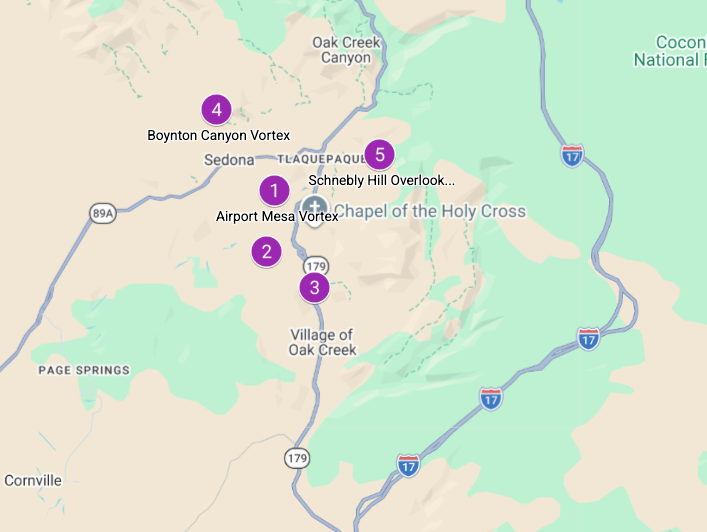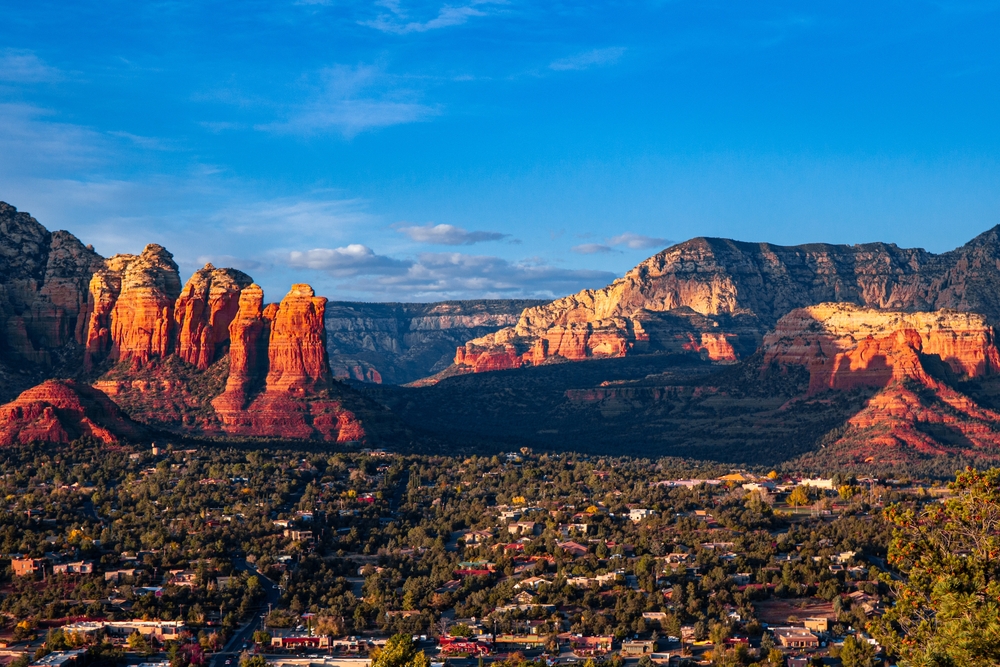
You feel Airport Mesa before you see the view. The short climb from the parking area is rocky, steep in a few spots, and shaded by twisted juniper trees whose trunks spiral in directions that make no botanical sense. Then you step onto the overlook — and every direction is Sedona. Thunder Mountain to the north. Cathedral Rock rising to the south. Coffeepot Rock, Chimney Rock, the long red spine of Capitol Butte — all of it spread out below you in a 360-degree panorama that stops most visitors mid-sentence.
This is Airport Mesa, and if you are searching for the Airport Mesa vortex Sedona locals know as the most intense of the four major energy sites, you have found it.
We have been based in Sedona since 1992, and over those three-plus decades we have sent more visitors to Airport Mesa than to any other single spot in town. Not because it is the most famous — Bell Rock wins that title — and not because the hike is the most dramatic — Cathedral Rock owns that. We send people here because Airport Mesa delivers the most concentrated vortex experience in the shortest amount of time, with the most spectacular view as a bonus. The vortex site is a five-minute walk from where you park your car. The sunset from this overlook is, in our opinion, the single best sunset viewpoint in Sedona. And the energy — if you are tuned into it — hits harder here than anywhere else in the valley.
Whether you come for the vortex, the views, or the golden hour light that turns these red rocks into something no camera fully captures, this is the complete Airport Mesa vortex Sedona resource from the people who have been walking this mesa for over thirty years.
The History and Lore of Airport Mesa
Airport Mesa’s story as a vortex site begins with the same woman who put all of Sedona on the spiritual map. In 1980, a psychic, author, and ordained Spiritualist minister named Page Bryant produced the first vortex map of Sedona. Bryant was the first apprentice of the Chippewa medicine man Sun Bear, with a background spanning astrology, Egyptology, shamanic practice, and earth mysteries. She claimed to channel an entity called Albion, and through those sessions she identified four specific locations in Sedona where the earth’s energy was unusually concentrated. She called them vortexes, published her findings in “The Earth Changes Survival Handbook” and later in “The Sedona Vortex Experience,” and in doing so she created the framework that still defines how the world talks about Sedona’s energy today. Airport Mesa was one of her original four.
But the land itself was significant long before Bryant arrived. The Yavapai and Apache peoples have ancestral ties to the Sedona area stretching back thousands of years. The Sinagua people built dwellings across these red rocks and left elaborate rock art telling stories of their culture and beliefs. For these indigenous peoples, the formations and mesas of Sedona were not tourist attractions or energy experiments — they were living parts of a spiritual landscape, woven into ceremony, healing, and daily life. Any honest conversation about the Airport Mesa vortex Sedona visitors seek out today has to acknowledge that this land carried meaning for millennia before the word “vortex” was spoken here.
The modern vortex story accelerated dramatically in August 1987, when the Harmonic Convergence brought roughly five thousand believers to Sedona for a globally synchronized meditation event. Tied to the Mayan calendar and promoted by author José Argüelles, the convergence was built on the idea that simultaneous meditation by 144,000 people worldwide would initiate a planetary shift. Sedona became one of the global focal points, and all four vortex sites — Airport Mesa included — were overrun with seekers, media crews, and curious onlookers. The national coverage cemented Sedona’s reputation as a spiritual destination, and that reputation has only grown since.
Airport Mesa has its own wrinkle in the story that the other three sites do not share. Because the vortex sits immediately adjacent to Sedona Airport — literally next to the runway — the earliest wave of vortex tourism created an unexpected problem: spiritual seekers wandering onto active airport property looking for the energy center. The foot traffic became enough of an operational concern that the designated vortex site was eventually relocated to where it sits today, on a small red rock mound just off the Airport Loop Trail, safely away from aircraft operations. It is one of those details that captures the strange, wonderful collision between the mystical and the mundane that makes Sedona unlike anywhere else.
Airport Mesa’s Energy: What Type of Vortex Is It?
Of the four major Sedona vortexes, Airport Mesa carries the strongest masculine energy. In the framework Page Bryant established — and that local practitioners still use — masculine or electric energy is associated with strengthening, activation, outward expression, and forward momentum. Feminine or magnetic energy is associated with nurturing, introspection, and inward reflection. Airport Mesa is firmly on the masculine, electric end of that spectrum, with an upflow of energy that practitioners describe as rising up through the rock and outward through the mesa’s summit.
If Bell Rock’s balanced energy is the approachable introduction to Sedona’s vortexes, and Cathedral Rock’s feminine energy is the place people go to feel held and process deep emotion, Airport Mesa is the activator. This is the vortex people visit when they want clarity, when they need to shake loose from indecision, when they are looking for the energetic equivalent of a strong cup of coffee on a cold morning. Visitors frequently report feelings of heightened mental sharpness, a surge of confidence, creative inspiration, and a sense of lightness — as though the heaviness they carried up the trail has been lifted off them by the time they reach the overlook.
The upflow designation means the energy is said to move upward through the earth and out through the rock. If you have felt the subtle tingling and buzzing that people describe at Bell Rock, expect that sensation amplified at Airport Mesa. The energy here is not gentle. Longtime practitioners in Sedona describe it as sharp, focused, and activating — the kind of energy that does not wait for you to be ready.
Where is the Airport Mesa vortex Sedona energy strongest? Most local guides point to the small red rock mound at the main overlook, just a few hundred feet from the trailhead. This is where the panoramic view opens up and where the majority of visitors who report strong sensations say they feel them most intensely. You will notice the twisted juniper trees growing nearby — their spiraling trunks appearing most dramatically on the eastern edge of the mesa. Whether you attribute the twisting to vortex energy or to wind and soil conditions, the concentration of these unusual growth patterns at the vortex site is striking and consistent across all four of Sedona’s major energy locations.
For first-time vortex visitors, we often suggest starting at Bell Rock for a gentler introduction. But if you have limited time in Sedona and want the most powerful experience with the least amount of hiking, Airport Mesa is the one. Five minutes from the car to the vortex, and the energy does not hold back.
What It Feels Like: Experiences at Airport Mesa
After more than thirty years of talking with visitors who have just come down from the Airport Mesa vortex Sedona is known for, we have heard a pattern of descriptions that is remarkably consistent.
The most commonly reported sensations at Airport Mesa include a buzzing or vibrating feeling through the body — often described as more pronounced here than at the other three sites — tingling or warmth in the hands and feet, a sudden sense of mental clarity or focus that feels like fog lifting, a burst of energy or motivation, and for some people, an emotional release that catches them off guard. The emotions at Airport Mesa tend to be different from those reported at Cathedral Rock. Where Cathedral Rock often brings tears of grief or tenderness, Airport Mesa’s emotional releases tend to be more like a dam breaking on frustration, stagnation, or decisions that have been put off too long. People walk up uncertain and come down decided.
Not everyone feels something, and that is perfectly normal. Sensitivity varies, and some visitors who feel nothing at Airport Mesa report powerful experiences at Cathedral Rock or Boynton Canyon instead. Others feel nothing on their first visit and then have a vivid experience on a return trip. Some report delayed effects — vivid dreams, a sudden surge of creative energy in the days following, or a lingering sense of clarity that persists long after leaving Sedona.
The skeptical explanation is reasonable: the combination of physical exertion, altitude, extraordinary natural beauty, and the expectation of feeling something creates a feedback loop that produces real physiological responses. The spiritual explanation is equally straightforward: the earth’s energy is concentrated here, and it is the strongest masculine expression of that energy in Sedona. Whichever framework you bring, the consistency of reported experiences across thousands of visitors over decades is worth taking seriously.
Our suggestion for the Airport Mesa vortex: find a flat spot on the rock, sit down, place your palms face-up on your knees or flat against the stone, and breathe slowly. Give yourself at least fifteen to twenty minutes. Unlike Bell Rock, where you may need to hike a while before finding the energy zone, the Airport Mesa vortex is immediate — you are standing on it almost as soon as you arrive. Use that directness. Do not rush. The sunset crowd will come and go around you. The energy does not leave with them.
The Geology Beneath Your Feet
Understanding the Airport Mesa vortex Sedona experience starts with what you are standing on. Airport Mesa is composed primarily of the Schnebly Hill Formation — the same distinctive dark red sandstone that gives Bell Rock, Cathedral Rock, and the other major formations their color. This formation is 800 to 1,000 feet thick, found only in the immediate Sedona vicinity, and dates to the Permian Period, approximately 275 to 300 million years ago.
During the Permian, this region sat at the edge of an ancient coastal sea called the Pedregosa Sea. Wide-ranging tides repeatedly washed over coastal sand dunes, compressing them into the horizontal layers of sandstone you can see in cross-section throughout Sedona’s canyon walls. Over geological time, iron oxide — hematite — seeped through the stone and stained it the deep red that makes Sedona famous. That color is, in the most literal sense, rust. The same element that carries oxygen through your blood painted these rocks red a quarter of a billion years ago.
What makes Airport Mesa geologically distinct from the other vortex sites is its shape. Bell Rock is a freestanding bell-shaped butte sculpted by differential erosion. Cathedral Rock is a series of spires and saddles. Boynton Canyon is a sheltered box canyon. Airport Mesa is a flat-topped mesa — a broad, elevated platform that resists erosion along its harder capstone layers while the softer rock around and beneath it wears away. That tabletop profile is what made it suitable for an airport runway in the first place, and it is what gives the vortex site its extraordinary panoramic exposure. You are standing on a geological platform that juts above the surrounding valley, open to sky in every direction, with nothing between you and the horizon but red rock and light.
The mesa rises to approximately 4,700 feet above sea level. The surrounding valley floor sits lower, which means you gain a genuine sense of elevation even though the walk from the parking area is short. That combination — geological elevation, open exposure, and 360-degree unobstructed views — is unique among the four vortex sites. Whether or not you subscribe to the energy framework, the physical experience of standing on Airport Mesa is different from standing at any other point in Sedona.
Hiking Airport Mesa: The Complete Trail Guide
The Airport Mesa vortex Sedona hikers visit offers two very different experiences depending on how much time you have.
The Vortex Walk is the quick route. From the lower parking area on Airport Road, a short trail climbs approximately 0.2 miles to the main vortex overlook. The walk takes five to ten minutes, gains modest elevation on rocky terrain, and deposits you at the panoramic viewpoint where the vortex energy is said to be strongest. This is the most accessible vortex site in Sedona — no long approach hike, no scrambling, no route-finding. If you have thirty minutes and want the full Airport Mesa vortex Sedona experience, this is the way to do it.
The Airport Mesa Loop Trail is the longer option and well worth the time if you have it. The full loop covers approximately 3.3 miles with around 400 to 500 feet of elevation gain and is rated moderate. The trail circles the entire mesa, offering continuously changing perspectives of Sedona’s red rock formations. The terrain is rocky throughout — sturdy footwear matters — with some steep sections and narrow passages, particularly around the summit area. Most visitors complete the loop in one and a half to two hours at a moderate pace.
The loop delivers views you will not get anywhere else on a single trail. The north side looks out toward Thunder Mountain and Coffeepot Rock. The south side opens to Cathedral Rock and the Village of Oak Creek. The east side faces Bell Rock and Courthouse Butte in the distance. Every turn on the trail brings a different composition, and photographers who hike the full loop at golden hour rarely complain about the effort.
Getting there: From the junction of Routes 89A and 179 in uptown Sedona, take 89A west for one mile to Airport Road on your left. Turn left and drive up the hill. The lower parking area — the one closest to the vortex site — is on your left about halfway up the hill and has space for roughly ten cars. A larger parking area is available further up near the airport overlook for three dollars.
Parking reality: The lower lot is almost always full, especially from mid-afternoon through sunset. If you want a spot, arrive early — before 8:00 a.m. for morning visits, or at least an hour before sunset for evening visits. If the lower lot is full, use the upper lot and walk down to the vortex site, or park at the Airport Loop Trailhead and take the longer loop to reach the overlook from the opposite direction.
Red Rock Pass: Unlike Bell Rock and Cathedral Rock, Airport Mesa does not require a Red Rock Pass to park. This is one of the few popular vortex trailheads in Sedona where parking is free at the lower lot (the upper lot charges a small fee).
Practical details: Dogs are allowed on leash on the loop trail. The trail is not stroller-accessible — the terrain is too rocky. There are no restroom facilities at the lower trailhead. Sun exposure is significant on the loop trail, with very little shade. Carry water even for the short vortex walk.
When to Visit and How to Prepare
Timing your Airport Mesa vortex Sedona visit well makes a real difference — and this site, more than any of the other three, rewards specific timing.

For sunset — and Airport Mesa is the undisputed sunset champion of Sedona’s vortexes — plan to arrive at least forty-five minutes before the sun drops. You want time to walk to the overlook, find a good vantage point, settle in, and watch the light show unfold. The last thirty minutes before sunset, the red rocks across the valley shift through a spectrum of orange, crimson, and deep purple that defies description. The iron oxide in the sandstone catches the low-angle light and amplifies it. Watching this happen from the Airport Mesa overlook, with the vortex energy humming beneath you, is one of the singular experiences in Sedona.
For sunrise, Airport Mesa is equally spectacular but far less crowded. The first light hits the eastern formations — Bell Rock and Courthouse Butte — while the western rocks remain in shadow, creating a contrast that is extraordinary for photography and for quiet contemplation. Sunrise visitors often have the vortex overlook nearly to themselves.
For the vortex experience specifically, early morning is our recommendation. The crowds are thin, the air is cool, and the energy — according to practitioners — is at its morning peak before the day’s foot traffic stirs things up. If you arrive at sunrise and stay for the twenty minutes after, you will have the kind of uninterrupted space that makes meditation at a vortex site actually possible.
Best seasons: Spring (March through May) and fall (September through November) offer the most comfortable temperatures and the best light. Summer in Sedona regularly exceeds 100°F — if you visit between June and August, come at sunrise or wait until an hour before sunset. Do not hike the full loop trail at midday in summer. Winter brings cooler temperatures, thinner crowds, and occasionally stunning conditions when snow dusts the red rocks while the sky stays blue.
What to bring: Water — a minimum of one liter for the short vortex walk, two liters for the full loop. Sun protection including a hat, sunscreen, and sunglasses year-round. Trail shoes with good grip for the rocky terrain. Layers, especially for sunrise and sunset visits when temperatures can swing significantly. A journal or your phone’s voice recorder if you want to capture thoughts while they are fresh — the clarity people report at Airport Mesa tends to fade if you do not record it.
Meditation tips for the Airport Mesa vortex: The energy here is strong and activating, so grounding yourself before you open up to it is important. Sit on the rock, close your eyes, take ten slow breaths to settle, and then simply pay attention. Notice what you feel in your hands first — that is where most people at Airport Mesa report the earliest sensations. Do not try to force calm. This vortex is not about calm. It is about activation, clarity, and forward movement. Let the energy do what it does.
Airport Mesa vs. the Other Three Vortexes: Which Is Right for You?
One of the most common questions about the Airport Mesa vortex Sedona visitors ask is how it compares to the other three major sites. Here is what we have observed over three decades of guiding visitors.
Airport Mesa vs. Bell Rock: Bell Rock is a balanced vortex with a slightly masculine lean — energizing but grounded, activating but gentle. Airport Mesa is the stronger masculine expression — sharper, more intense, more immediately felt. Bell Rock requires a longer approach and optional scramble to reach the energy zone. Airport Mesa puts you at the vortex site in five minutes. If you are a first-time vortex visitor and want a gentler introduction, start at Bell Rock. If you want intensity, directness, and the best sunset in Sedona, Airport Mesa is the pick.
Airport Mesa vs. Cathedral Rock: These two are energetic opposites. Cathedral Rock is the strongest feminine, magnetic vortex — its energy draws inward and is associated with emotional healing, heart-opening, and deep reflection. The hike to reach Cathedral Rock’s energy zone is a moderate-to-challenging rock scramble. Airport Mesa’s masculine, electric energy pushes outward — clarity, motivation, activation. If you are processing grief, heartbreak, or deep emotion, Cathedral Rock is where you go. If you need to break through stagnation, make a decision, or reignite your sense of direction, Airport Mesa is the answer.
Airport Mesa vs. Boynton Canyon: Boynton Canyon is the most evenly balanced of all four vortexes, harmoniously blending masculine and feminine energy. It requires a longer hike through a beautiful and relatively secluded canyon, and it draws fewer crowds than the other three sites. Boynton Canyon’s energy is subtle and integrative — people go there for wholeness. Airport Mesa’s energy is anything but subtle. If you want a quiet, meditative canyon experience with balanced energy, choose Boynton Canyon. If you want the most powerful, direct masculine energy with panoramic views and easy access, Airport Mesa is unmatched.
Our recommendation: If you only have time for one vortex, it depends on what you need. Airport Mesa is the right choice for visitors who want the strongest energy experience with the easiest access and the best views. It is also the best choice for anyone visiting Sedona specifically at sunset — there is no competition. For first-timers who are unsure what to expect, Bell Rock’s gentler balance may be a more welcoming introduction. But if you know what you came for and you want intensity, Airport Mesa will not disappoint.
Local Tips From 30+ Years in Sedona
After guiding visitors to the Airport Mesa vortex Sedona area since 1992, here are the things we wish every first-timer knew.
The sunset crowd arrives late and leaves fast. Most people show up fifteen minutes before sunset, watch the sun drop, take photos, and leave within ten minutes of the sky going dark. If you arrive forty-five minutes early and stay thirty minutes after sunset, you will experience the overlook nearly empty at both ends — and the post-sunset light, when the sky turns purple and the rocks glow from residual warmth, is arguably more beautiful than the sunset itself.
The lower parking lot is the bottleneck, not the trail. On busy evenings, cars circle the small lot waiting for spaces while the overlook itself has plenty of room. If the lot is full, park at the upper lot and walk down. It adds five minutes to your approach and saves twenty minutes of frustration.
Sunrise at Airport Mesa is Sedona’s best-kept accessible secret. The sunset reputation is so dominant that most visitors never consider coming here at dawn. The light is extraordinary, the vortex is yours alone, and the energy — if you are receptive to it — is at its clearest before the day heats up.
The full Airport Mesa Loop Trail is dramatically underrated. Most visitors walk to the vortex overlook, take their photos, and leave. The loop trail circles the entire mesa and delivers views from angles that most Sedona visitors never see. If you have two hours, hike the loop. You will not regret it.
Look up. Airport Mesa sits directly adjacent to Sedona Airport, and small planes approach and depart regularly. Watching a private plane bank between red rock formations as it lines up for the runway — from the mesa that sits at runway elevation — is one of those only-in-Sedona moments that no guidebook mentions.
Frequently Asked Questions About the Airport Mesa Vortex Sedona
Is Airport Mesa a vortex? Yes. The Airport Mesa vortex Sedona is famous for is one of the four major energy sites originally identified by psychic Page Bryant in 1980. It is classified as a masculine, electric vortex with strong upflow energy — the most intense of the four sites.
How long is the hike to the Airport Mesa vortex? The vortex overlook is approximately 0.2 miles from the lower parking area — a five-to-ten-minute walk on rocky terrain. The full Airport Mesa Loop Trail is 3.3 miles and takes one and a half to two hours.
Do you need a Red Rock Pass for Airport Mesa? No. Unlike Bell Rock and Cathedral Rock, the Airport Mesa lower trailhead does not require a Red Rock Pass. The upper parking area near the airport overlook charges a small fee of three dollars.
When is the best time to visit Airport Mesa? Sunset is the most popular and spectacular time, but arrive at least forty-five minutes early to secure parking and a good viewpoint. Sunrise offers equal beauty with far fewer crowds. For the vortex experience specifically, early morning is ideal.
Where is the vortex energy strongest at Airport Mesa? Most local guides and practitioners identify the small red rock mound at the main overlook — approximately 200 feet from the Airport Loop Trailhead — as the strongest energy point. The twisted juniper trees on the eastern edge of the mesa are also frequently cited as indicators of concentrated energy.
Is Airport Mesa good for beginners? Yes and no. The short walk to the vortex is easy and accessible. But the energy at Airport Mesa is the most intense of the four sites. First-time vortex visitors who want a gentler introduction may prefer to start at Bell Rock. Those who want to dive straight into a powerful experience will find Airport Mesa delivers immediately.
Can you see the sunset from Airport Mesa? Airport Mesa is widely considered the best sunset viewpoint in all of Sedona. The 360-degree panoramic view from the overlook provides unobstructed sightlines to the western horizon, and the low-angle light transforms the surrounding red rock formations into a display of color that draws crowds every clear evening.
What should I wear to hike Airport Mesa? Trail shoes or hiking shoes with good grip are essential — the terrain is rocky throughout. For the short vortex walk, sturdy sneakers work. For the full loop trail, proper hiking footwear is recommended. Bring layers for sunrise and sunset visits, a hat, and sunglasses year-round.
Airport Mesa has been standing here for roughly 300 million years — first as a seashore at the edge of a Permian ocean, then as sediment compressing into stone, then as that stone slowly rising and eroding into the flat-topped mesa you stand on today. The Yavapai knew this land carried power. Page Bryant gave that power a name. The five thousand seekers who gathered here during the Harmonic Convergence spread the name across the world.
But the mesa does not need a name or a framework to do what it does. Stand at the overlook at sunset and watch the light pour across the valley. Feel the rock under your feet — the same iron that colors the stone runs through your veins. If the energy rises through you, let it. If it does not, the view alone is worth the walk.
Whatever brought you to Airport Mesa — the vortex, the sunset, the curiosity, or something you cannot quite name — give it more than a quick photo stop. Stay. Breathe. Let the mesa do what it has been doing for a quarter of a billion years.
Airport Mesa is one of four major vortex energy sites in Sedona. Read our complete guide to Sedona’s vortexes for an overview of all four sites, or explore our guides to Bell Rock Vortex, Boynton Canyon Vortex, and Cathedral Rock Vortex.