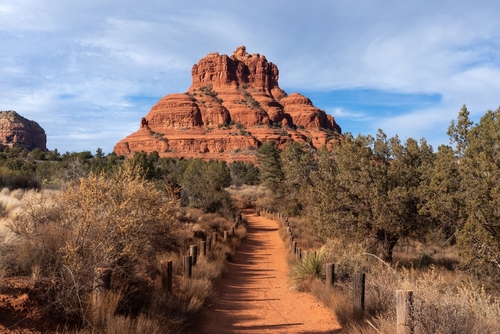
You can see Bell Rock for miles before you reach it. Driving south on Highway 179 toward the Village of Oak Creek, the formation rises from the valley floor like a massive red sandstone bell — unmistakable, iconic, and pulling you toward it long before you reach the trailhead. It is, without question, the single most recognizable landmark in Sedona — and if you are searching for the Bell Rock vortex Sedona experience, this is where it begins.
We have been based in Sedona since 1992, and in those three-plus decades we have watched Bell Rock draw millions of visitors — hikers chasing the scramble, photographers hunting the golden hour, and spiritual seekers searching for something they cannot quite name. Many of them arrive expecting a pleasant trail with pretty views. What they find, more often than not, is something they did not expect to feel.
Bell Rock is one of Sedona’s four major energy vortex sites, and it may be the most approachable of them all. This guide covers everything you need to know about the Bell Rock vortex Sedona locals talk about: the trail, the energy, the deep history and lore that most guides skip over, and the practical details you need to plan your visit. Whether you come for the hike or the energy — or both — this is the complete Bell Rock vortex Sedona resource from the people who know this rock better than anyone.
The History and Lore of Bell Rock
The land surrounding Bell Rock has been considered sacred for far longer than the word “vortex” has been attached to it. The Yavapai-Apache Nation has ancestral ties to this area stretching back thousands of years. For these indigenous peoples, the red rock formations were not tourist attractions — they were living parts of a spiritual landscape, used for ceremony, healing, and connection to the natural world. Any honest conversation about the Bell Rock vortex Sedona is known for has to start there.
The modern vortex story begins in the early 1980s with a woman named Page Bryant. Bryant was a psychic, author, and ordained Spiritualist minister — the first apprentice of the Chippewa medicine man Sun Bear — with a background that spanned astrology, Egyptology, shamanic practice, and earth mysteries.
She claimed to channel an entity called Albion, and through those sessions she identified four specific locations in Sedona where the earth’s energy was unusually concentrated. She called them vortexes. Bell Rock was one of the four. Page Bryant died in 2017, but the framework she created still defines how the world talks about Sedona’s energy.
Then came August 1987 and the Harmonic Convergence — a globally synchronized meditation event tied to the Mayan calendar and promoted by author José Argüelles. Roughly five thousand believers descended on Sedona to meditate at the vortex sites, and Bell Rock became ground zero for the gathering.
National media covered the event with a mix of fascination and skepticism, but the publicity did something permanent: it put Sedona on the map as a spiritual destination, and it planted Bell Rock at the center of that identity.
The lore only deepened from there. Over the years, Bell Rock became a magnet for UFO culture and fringe theories.
One persistent legend claims that a massive crystal is buried deep beneath the formation, placed there by an ancient or extraterrestrial civilization. Others believe Bell Rock itself is an alien spacecraft lodged in the earth, waiting to be activated.
The most colorful chapter belongs to Peter Gersten, a New York attorney who spent decades representing UFO groups in Freedom of Information Act lawsuits — earning himself the nickname “the UFO Lawyer.” Gersten eventually moved to Sedona, became convinced that Bell Rock was an inter-dimensional portal, and by the winter solstice of 2018 had led over a thousand people to the rock’s summit for a group meditation.
You do not have to believe any of these stories to appreciate what they reveal: Bell Rock has been pulling people toward it — literally and figuratively — for a very long time, and the pull shows no sign of weakening.
Bell Rock’s Energy: What Type of Vortex Is It?
If you research Bell Rock’s vortex energy before visiting, you will run into contradictory information almost immediately. Some sources call it a masculine vortex. Others say balanced. Some describe the energy as electric and upflowing, while others emphasize a blend of masculine and feminine qualities. The confusion is real and worth clearing up.
The Bell Rock vortex Sedona visitors ask about most is best understood as a balanced vortex with a slightly masculine lean and an upflow of electric energy. In the vortex framework that has been used in Sedona since Bryant’s original mapping, masculine or electric energy is associated with strengthening, motivation, and outward expression. Feminine or magnetic energy is associated with nurturing, introspection, and inward reflection. Bell Rock carries both, but the masculine side is slightly dominant — which is why visitors frequently report feelings of clarity, confidence, and a sense of being energized rather than deeply relaxed.
The upflow designation means the energy is said to move upward through the earth and out through the rock itself. If you have ever stood on Bell Rock and felt a subtle buzzing or lightness in your body — particularly in your hands and feet — that sensation aligns with what upflow-energy proponents describe.
By contrast, Cathedral Rock is a feminine, inflow vortex — people go there to feel held, to process emotion, to turn inward. Airport Mesa is a strong masculine, electric site — sharp, intense, activating. Boynton Canyon is the most balanced of all four. Bell Rock sits between Airport Mesa and Boynton Canyon on the spectrum: energizing but not overwhelming, activating but grounded.
Where is the Bell Rock vortex Sedona energy strongest? Most local guides and longtime practitioners point to the saddle area on the southwest face of Bell Rock, roughly halfway up the formation. You will find flat rock shelves there that are perfect for sitting, and this is where the majority of people who report strong sensations say they feel them. Look for the twisted juniper trees growing near these spots — their spiraling trunks are often cited as physical indicators of vortex energy, and you will find them growing more dramatically near what practitioners consider the vortex center.
What It Feels Like: Experiences at Bell Rock
After more than thirty years of guiding people to the Bell Rock vortex Sedona is known for, we have talked with visitors who have just come off the trail, we have heard a wide and surprisingly consistent range of descriptions. The most commonly reported sensations include tingling or warmth in the hands and feet, a buzzing or vibrating feeling through the body, sudden emotional release — sometimes tears that seem to come from nowhere — heightened mental clarity, a deep sense of stillness, and spontaneous insights or ideas that feel like they arrived from outside the person’s own thinking.
Not everyone feels something, and sensitivity varies enormously. Local guides estimate that roughly three out of four visitors report some kind of unusual sensation at the vortex sites, ranging from subtle to overwhelming. Some people feel nothing on their first visit and then have a powerful experience on a return trip. Others report delayed effects — vivid dreams that night, unexpected emotional shifts in the days following, or a lingering sense of calm that persists long after leaving Sedona.
The skeptical explanation for the Bell Rock vortex Sedona phenomenon is straightforward: the combination of physical exertion, stunning natural beauty, high-altitude light, and the expectation of feeling something creates a feedback loop that produces real physiological sensations. The spiritual explanation is equally straightforward: the earth’s energy is concentrated here, and your body can feel it when you slow down enough to notice. Whichever framework you bring, the reported experiences are remarkably similar across thousands of visitors over decades, and that consistency is worth taking seriously regardless of how you explain it.
Our suggestion: do not arrive trying to force a specific experience. Sit on the rock, get quiet, put your palms face-up on your knees, breathe slowly, and give yourself at least twenty minutes. If something happens, it happens. If it does not, you are still sitting on one of the most beautiful formations in Arizona with a view that stretches to the Mogollon Rim.
The Geology Beneath Your Feet
Understanding what makes the Bell Rock vortex Sedona experience unique starts with the geology.
Whether or not you feel vortex energy at Bell Rock, you are sitting on something genuinely extraordinary: roughly 275 million years of earth history compressed into red stone beneath you.
Bell Rock is composed primarily of the Bell Rock Member of the Schnebly Hill Formation — a layer of Permian-era sandstone that was created when ancient sea tides repeatedly washed over and flattened coastal sand dunes into horizontal layers. Over millions of years, iron oxide — hematite — seeped through the sandstone and stained it the deep red that makes Sedona famous. That red is, in the most literal sense, rust. The iron came from minerals in the original sediment and was deposited as groundwater moved through the rock over geological time.
The formation rises approximately 300 to 500 feet above the surrounding valley floor, depending on where you measure from. Its distinctive bell shape is the result of differential erosion: the horizontal sandstone layers erode at different rates, creating the stepped, tapering profile that gives the rock its name. The harder capstone layers resist erosion while softer layers beneath them wear away, producing the shelves and ledges that hikers scramble across today.
For some visitors, the geology deepens the spiritual experience rather than replacing it. There is something grounding about knowing that the rock under your hands was once a seashore at the edge of a Permian ocean, and that the red color you see is the same iron that carries oxygen through your blood. The connection between your body and this rock is not metaphorical — it is chemical.
Hiking Bell Rock: The Complete Trail Guide
The Bell Rock vortex Sedona hikers love offers multiple route options that range from an easy stroll to a serious scramble, making it one of the most versatile trails in Sedona.
Bell Rock Pathway is the main loop trail that circles the base of the formation. It covers 3.6 miles with approximately 340 feet of elevation gain and is rated easy to moderate. The packed red dirt path is well-maintained and accessible to most fitness levels, including families with older children and anyone comfortable walking on gentle terrain. This is the route most visitors take, and it delivers stunning views of both Bell Rock and the adjacent Courthouse Butte formation without requiring any climbing.
Courthouse Butte Loop extends the hike to 4.1 miles by circling around Courthouse Butte as well. The terrain is similar — relatively flat with modest elevation change — and the added distance gives you a more complete experience of the area with fewer crowds on the far side of Courthouse Butte.
The Bell Rock Scramble is where the hike becomes a climb. Starting from the south face at approximately 0.8 miles from the trailhead, informal routes lead up the slickrock toward the higher ledges and the saddle area. There is no marked trail above the first shelf. The initial scramble is moderate and manageable for most reasonably fit hikers with good footwear. The higher you go, the steeper and more exposed it becomes, requiring hands-and-feet climbing on smooth sandstone with limited footholds.
Most people find a comfortable ledge somewhere in the lower-to-middle section and stop there — which is also where the vortex energy is said to be strongest. Attempting the upper sections is risky, especially in wet conditions when the slickrock becomes slippery, and there is no safe route to the very top.
Parking: The Bell Rock Pathway Trailhead is located on Highway 179 in the Village of Oak Creek, approximately five miles south of uptown Sedona. GPS coordinates are 34.8047° N, 111.7663° W. A Red Rock Pass is required and costs between five and fifteen dollars per day. The main lot fills early on weekends and during peak season — plan to arrive before 8:00 a.m. or use the overflow lot across the highway.
Practical details: Dogs are allowed on leash. The lower pathway is stroller-accessible. Vault toilets are available at the trailhead parking lot. There is no shade on the trail, so sun protection is essential year-round.

When to Visit and How to Prepare
Timing your Bell Rock vortex Sedona trip well makes a real difference. The best time to visit Bell Rock depends on what you are looking for. For the hiking and vortex experience combined, early morning is ideal — cooler temperatures, available parking, softer light, and fewer people on the rock. Sunrise at Bell Rock is spectacular, with the first light turning the red sandstone to a deep orange glow that no photograph fully captures.
The best seasons to visit the Bell Rock vortex Sedona area are spring, from March through May, and fall, from September through November. Temperatures are comfortable, the light is extraordinary, and the crowds are present but manageable. Summer in Sedona regularly exceeds 100°F at midday — if you visit between June and August, start your hike before 7:00 a.m. and be off the rock by late morning. Winter brings cooler temperatures and thinner crowds, but the rock can be icy in shaded spots after cold nights.
What to bring: A minimum of two liters of water per person, sun protection including a hat, sunscreen, and sunglasses, trail shoes with sticky rubber soles if you plan to scramble, a journal if you want to record your experience while it is fresh, and layered clothing since temperatures can swing 30 degrees between sunrise and midday.
Meditation tips for the vortex: Find a flat spot on the rock where you feel comfortable sitting for at least fifteen to twenty minutes. Ground yourself by placing your palms on the stone or face-up on your knees. Breathe slowly and deeply — a four-count inhale, four-count hold, four-count exhale pattern works well. Many people report stronger sensations in their palms, so pay attention to your hands. Do not force anything. Let the experience come to you.
Bell Rock vs. the Other Three Vortexes: Which Is Right for You?
One of the most common questions about the Bell Rock vortex Sedona visitors ask is which site to visit, especially from people with limited time in Sedona. Here is how the Bell Rock vortex Sedona visitors love compares to the other three major sites, based on what we have observed over three decades.
Bell Rock vs. Cathedral Rock: These two get compared the most. Cathedral Rock is a feminine, magnetic vortex — its energy draws inward and is associated with emotional healing, heart-opening, and deep reflection. The hike is moderate to challenging with a steep rock scramble. Bell Rock’s balanced, slightly masculine energy is better suited for clarity, intention-setting, and energizing experiences. The hike is easier and more accessible. If you are processing grief, heartbreak, or deep emotion, Cathedral Rock may serve you better. If you want activation, confidence, and grounded energy, Bell Rock is the choice.
Bell Rock vs. Airport Mesa: Airport Mesa is the strongest masculine, electric vortex of the four — sharp, intense, and activating. It is also the easiest to reach, with a parking lot near the vortex site. Bell Rock’s energy is gentler and more balanced by comparison. For first-time vortex visitors, Bell Rock is often the better introduction because the energy is powerful but not overwhelming. Airport Mesa is better for experienced seekers who want intensity and panoramic sunset views.
Bell Rock vs. Boynton Canyon: Boynton Canyon is the most balanced of all four vortexes, blending masculine and feminine energy harmoniously. It requires a longer hike through a beautiful canyon and tends to draw fewer crowds. If you have more time and want a more secluded, meditative experience, Boynton Canyon is excellent. If you want an iconic Sedona landmark with accessible energy and multiple route options, Bell Rock is the pick.
Our recommendation for first-timers: Start at Bell Rock. Its balanced energy is welcoming, the trail is forgiving, the scramble is optional, and the visual impact is unmatched. You can visit the base, the vortex zone, or the scramble and have three different experiences in one visit. It is the vortex that gives the widest range of visitors the best chance of connecting with whatever Sedona’s energy has to offer.
Local Tips From 30+ Years in Sedona
After guiding visitors to the Bell Rock vortex Sedona area since 1992, here are the things we wish every first-timer knew.
A few things we have learned from being here since 1992 that most guides do not mention:
The twenty minutes after sunrise is the window. Most visitors arrive for sunrise itself, take their photos, and leave. The people who stay an extra twenty minutes get the rock nearly to themselves, the light gets even better as it warms, and the energy — if you are tuned into it — is at its morning peak.
The south face gets the earliest crowds because it is closest to the parking lot. If you want a quieter experience, take the pathway around to the east or northeast side of Bell Rock before finding a spot to sit. The views are different, the rock is the same, and you may have an entire shelf to yourself.
Courthouse Butte, which sits right next to Bell Rock, is one of the most underrated formations in Sedona. Adding the Courthouse Butte Loop to your Bell Rock visit turns a good hike into a great one, and the far side of Courthouse Butte is one of the quietest spots on any popular trail in the area.
If the parking lot is full — and on spring and fall weekends it will be by 9:00 a.m. — check the overflow lot on the opposite side of Highway 179. It adds a few minutes to your walk but it almost always has space.
Frequently Asked Questions About the Bell Rock Vortex Sedona
Is Bell Rock a vortex?
Yes. The Bell Rock vortex Sedona is famous for is one of the four major energy sites, originally identified by psychic Page Bryant in the early 1980s. It is classified as a balanced vortex with slightly masculine, upflow energy.
Can you hike to the top of Bell Rock?
There is no marked trail to the summit. Most hikers scramble partway up the slickrock to a comfortable ledge or the saddle area. The upper sections are steep, exposed, and dangerous — especially in wet conditions. We do not recommend attempting the very top.
How long does it take to hike Bell Rock?
The base loop on Bell Rock Pathway takes most visitors one to two hours. Add another thirty to sixty minutes if you scramble up the rock. The full Courthouse Butte Loop takes two to three hours at a moderate pace.
Where is the vortex energy strongest at Bell Rock?
Most local guides and practitioners identify the saddle area on the southwest face, roughly halfway up the formation, as the strongest energy point. Look for the twisted juniper trees — they tend to concentrate near the vortex center.
Do you need a Red Rock Pass for Bell Rock?
Yes. A Red Rock Pass is required to park at the Bell Rock vortex Sedona trailhead on Bell Rock Pathway. Day passes cost five to fifteen dollars and are available at the trailhead, local shops, and online through the Coconino National Forest website.
Is Bell Rock better than Cathedral Rock?
They are different experiences. Bell Rock offers balanced, energizing energy with an easy-to-moderate hike. Cathedral Rock offers feminine, nurturing energy with a more challenging scramble. Bell Rock is generally better for first-time vortex visitors and those seeking clarity. Cathedral Rock is better for emotional healing and deep introspection.
What should I wear to hike Bell Rock?
Trail shoes or hiking shoes with sticky rubber soles are essential if you plan to scramble. The slickrock is smooth sandstone and regular sneakers can slip. For the base pathway, any comfortable walking shoes work. Bring layers, a hat, and sunglasses year-round.
Bell Rock has been drawing people to it for longer than anyone alive can remember — long before Page Bryant, long before the Harmonic Convergence, long before the word vortex was ever spoken in Sedona. The Yavapai-Apache knew this land was special. The formation itself has been standing here for a quarter of a billion years, shaped by ancient oceans and painted red by iron and time.
Whatever brings you to Bell Rock — the hike, the energy, the history, or simple curiosity — give it more than a quick photo stop. Sit on the rock. Get quiet. Stay a while. In our experience, Bell Rock gives back exactly as much as you are willing to give it.
Have questions about visiting Bell Rock or any of Sedona’s vortex sites? Read our complete Sedona Vortex guide for everything you need to know about all four major energy centers.