Boynton Canyon Vortex Sedona Energy: What Type of Vortex Is It?
Of the four major Sedona vortexes, Boynton Canyon vortex is the only one classified as a true balanced or electromagnetic vortex — carrying both masculine and feminine energy in equal measure.
In the framework Page Bryant established, masculine (electric) energy is associated with activation, outward expression, and forward momentum. Feminine (magnetic) energy is associated with nurturing, introspection, and inward reflection. Bell Rock leans masculine. Cathedral Rock is the strongest feminine site. Airport Mesa pushes hard masculine energy upward.
Boynton Canyon does something none of them do: it holds both.
The canyon itself makes this visible. On one side stands Kachina Woman — the slender spire representing the feminine principle of nurturing and intuition. Across from her rises a broad, unnamed mesa that embodies the masculine principle of strength and grounding. The vortex energy sits in the saddle between them, in the tension and harmony of two forces that do not compete but complete each other.
Practitioners describe the effect as profoundly different from the other three sites. Where Airport Mesa pushes mental clarity and Cathedral Rock pulls emotional release, Boynton Canyon harmonizes. It does not push energy in one direction. It balances. Local practitioners and longtime visitors describe its particular gifts as strengthening relationships, deepening honesty and intimacy, healing emotional wounds, and cultivating a peace that comes from being genuinely centered.
If Bell Rock is where you go to think clearly and Airport Mesa is where you go to feel powerful, Boynton Canyon is where you go to feel whole.
What Does the Boynton Canyon Vortex Feel Like?
The experience at Boynton Canyon is distinct from the other three vortexes, and the canyon’s physical character has everything to do with it.
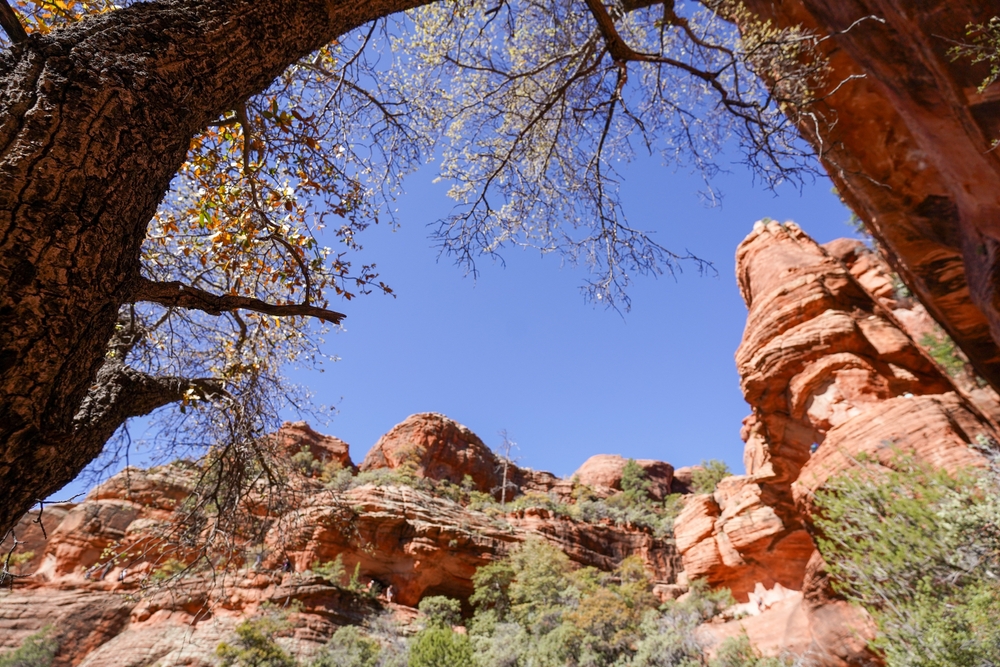
At Airport Mesa, you stand above the world. At Bell Rock, you sit in an open red rock amphitheater. Boynton Canyon encloses you. The walls rise on either side, the canopy of juniper and ponderosa pine filters the light, and there is a quality of quiet that does not exist at the more exposed sites. Visitors consistently describe feeling held — not constrained, but cradled by the landscape itself.
The energy at Boynton Canyon tends to be gentler than what people report at Airport Mesa or Cathedral Rock. It is less of a surge and more of a settling. First-time visitors frequently describe an overwhelming sense of calm that arrives without warning — one moment you are hiking, and the next moment something in your chest releases and you feel quieter than you have in months.
Physical sensations are common: tingling in the hands and feet, a relaxation that starts in the shoulders and moves through the body, a feeling of warmth or opening in the heart center. Emotional responses run the full range — some people feel joy, others feel a sadness that has been waiting to surface, and many describe a deep, uncomplicated peace.
The emotions at Boynton Canyon tend to be different from those reported at the other sites. Where Cathedral Rock often triggers cathartic release and Airport Mesa can produce euphoric clarity, Boynton Canyon’s balanced energy creates space for whatever needs to come up. It does not direct the experience. It makes room for it.
One thing we hear consistently from visitors after thirty-plus years: Boynton Canyon is the vortex they did not expect to be the most powerful, and the one they most want to return to.
The Geology Behind the Energy
Boynton Canyon’s distinctive enclosed feeling is not accidental — it is geological. The canyon formed when continental extension reactivated a pre-existing fault, causing the eastern side to drop roughly 200 meters lower than the western rim. The result is a deep, narrow box canyon carved into layers of iron-rich sandstone and limestone deposited over millions of years at the bottom of an ancient sea.
The red color that defines the canyon walls comes from hematite — iron oxide — blended throughout the sedimentary layers. The same mineral that gives these rocks their crimson intensity is the mineral that some researchers have pointed to when trying to explain the magnetic anomalies reported at vortex sites across Sedona. Whether the iron content is related to the energy people feel is an open question, but the geology and the spiritual experience converge in a way that is difficult to dismiss entirely.
What is not debatable is the effect the canyon’s shape has on the human experience of being in it. Unlike the open-sky exposure at Airport Mesa or the vertical drama of Cathedral Rock, Boynton Canyon wraps around you. The trail terminates at Boynton Box — a natural dead end where the canyon walls close in on three sides — and the sensation of walking deeper into an enclosed, living space is unlike anything the other vortex sites offer.
The canyon also creates a distinct microhabitat. The sheltered walls support a blend of desert and forest ecosystems that you will not find at the more exposed vortex locations. Ponderosa pine and alligator juniper grow alongside yucca and prickly pear. Manzanita and oak fill the middle zones. In spring, Indian paintbrush, lupine, and desert marigolds bring color to the canyon floor. In autumn, the deciduous trees turn gold against the red rock walls.
This is not just scenery. The ecological richness of Boynton Canyon contributes to its feeling of being a world apart — a place where the desert opens up into something more lush, more sheltered, and more alive than you expected.
Trail Guide: How to Reach the Boynton Canyon Vortex
There are two ways to experience Boynton Canyon, and you should know which one you want before you start walking.
The Short Route: Boynton Vista Trail (Vortex Point)
If you are coming specifically for the vortex energy, the Boynton Vista spur trail is your destination. This short trail branches off the main Boynton Canyon Trail about half a mile from the parking area and leads to the saddle between Kachina Woman and the unnamed knoll — the spot most practitioners identify as the primary vortex point.
Distance: Approximately 1.1 miles round trip
Difficulty: Easy
Time: 30 to 45 minutes
What to expect: A short, manageable walk to an overlook with views of Kachina Woman and the canyon entrance. This is where most visitors sit, meditate, or simply take in the energy. The vortex is thought to be centered in the saddle area between Kachina Woman and the knoll, though some practitioners feel the energy more strongly at the base or top of the knoll itself.
The Full Route: Boynton Canyon Trail
The full Boynton Canyon Trail takes you deep into the canyon itself, past the vortex point and into the narrowing corridor that terminates at Boynton Box.
Distance: 6 miles round trip
Difficulty: Moderate
Elevation gain: 931 feet
Time: 2.5 to 4 hours
What to expect: Creek crossings, elevation changes, and a gradual transition from open desert into a forested canyon. The trail terminates at the box canyon — a dramatic dead end that is worth every step.
The Extended Adventure: Subway Cave
For those wanting more, a spur trail leads to Subway Cave — a natural tunnel formation in the rocks with nearby cliff dwelling ruins. This adds about 0.65 miles round trip and requires some scrambling, but the payoff is significant.
Full combination (Vista + Canyon + Subway Cave): 7.5 miles round trip, 4.5 to 6.5 hours.
Parking and Logistics
Red Rock Pass: Required. Day passes cost $5, seven-day passes $15, annual passes $20. An America the Beautiful Pass also works.
Parking: The Boynton Canyon Trailhead lot fills early, especially on weekends and during peak season. If you arrive after 9 a.m. on a weekend, plan on competition. Overflow parking is available on Boynton Pass Road — turn left at the stop sign — but even that fills up by mid-morning on busy days.
Our advice: Arrive before 8 a.m. You will have the canyon to yourself, the light will be extraordinary, and you will not spend twenty minutes circling for a parking spot. This is one of the few vortex sites where timing makes a dramatic difference in the quality of your experience.
Practical details: Dogs are allowed but must be leashed at all times — bears, mountain lions, and javelina inhabit this canyon, and your dog needs to stay close. The trail is not stroller-accessible due to creek crossings and uneven terrain. Restroom facilities are available at the trailhead. Carry water — there is limited shade on the initial section of the trail, and Sedona’s elevation means the sun is stronger than you expect.
When to Visit the Boynton Canyon Vortex
Boynton Canyon is accessible year-round, but the experience varies dramatically by season.
September through May is the ideal window. Spring brings wildflowers to the canyon floor and comfortable temperatures for hiking. Fall adds golden foliage against the red walls — a color combination that photographs cannot adequately capture. These are also peak tourist seasons, so early arrivals matter.
Summer is hot but has a hidden advantage: significantly fewer visitors. If you can handle temperatures that may reach into the 90s, you will have the canyon nearly to yourself. Start early and finish before the heat peaks.
Winter brings cold temperatures that can drop below freezing, but also brings a silence and stillness that many longtime practitioners consider the best time to experience the vortex energy. Snow on red rock is one of Sedona’s most stunning visual moments, and it happens more often than most visitors expect.
The canyon’s enclosed geography means it stays cooler than the exposed vortex sites in summer and warmer in winter. The walls provide natural shelter from wind, and the canopy of trees along the trail offers shade that Airport Mesa and Bell Rock cannot match.
Sunrise at Boynton Canyon is a fundamentally different experience from sunset. The first light hits the upper canyon walls while the trail floor remains in shadow, and the contrast between warm light above and cool shade below creates a cathedral quality that is hard to describe and impossible to forget.

How Boynton Canyon Compares to the Other Three Vortexes
If you are trying to decide which vortex to visit — or which to visit first — understanding the differences matters.
Bell Rock is the accessible introduction. Balanced energy leaning masculine, visible from the road, a good place to test whether you feel anything at all. It is Sedona’s entry-level vortex in the best sense.
Airport Mesa is the power hit. Strong masculine energy, the best sunset view in Sedona, short walk from the parking lot. If you want intensity and a panorama, this is your site.
Cathedral Rock is the emotional deep dive. The strongest feminine energy of the four, a steep and potentially dangerous climb, and a site that tends to bring things to the surface whether you are ready for them or not.
Boynton Canyon is the one that changes how you think about the other three. Where the other sites tend toward one type of energy, Boynton holds both. Where the other sites expose you to the landscape, Boynton envelops you in it. Where the other sites have histories measured in decades, Boynton’s sacred significance is measured in millennia. It is the quietest of the four, the most difficult to access, and — in the opinion of most longtime Sedona residents we know — the most profound.
If you only have time for one vortex, the conventional advice is Bell Rock or Airport Mesa because they are easy. Our advice, after thirty-plus years, is Boynton Canyon — because easy is not the point.
The Enchantment Resort and the Canyon’s Modern Story
Any honest guide to Boynton Canyon needs to mention the Enchantment Resort, because the resort and the canyon’s sacred history are intertwined in ways that matter.
Enchantment Resort sits at the mouth of Boynton Canyon on Coconino National Forest land, and its development — which began in the mid-1980s and could not be permitted under current regulations — effectively positioned a luxury resort as the gateway to one of the Yavapai-Apache Nation’s holiest sites.
For years, the resort worked with Yavapai-Apache elder Bob Bear as a cultural advisor, resulting in a documentary about the canyon’s indigenous history. After Bear’s passing in 2014, that relationship became strained. The practical impact is real: Yavapai-Apache tribal members who wish to access their own sacred lands deep in the canyon must either hike the full trail or request passage through the resort.
We mention this not to cast judgment on the resort — which has made efforts at preservation and cultural partnership — but because understanding this history is part of understanding Boynton Canyon. The tension between tourism and indigenous sacred access is a live issue, and visitors who know about it tend to walk the canyon with a different kind of awareness.
Local Tips from Three Decades in Sedona
Start with the Vista, then decide. Walk the half-mile to the Boynton Vista spur trail and spend time at the vortex point first. If the canyon calls you deeper, you will know, and the full trail will reward the commitment. If you came for the energy, the Vista delivers.
Go alone if you can. Boynton Canyon’s power is in its quiet. Groups change the dynamic — conversation fills the silence, and the pace becomes social rather than contemplative. If this is your first visit, consider going solo or with one person who understands what you are there to do.
Morning beats afternoon. The light in the canyon during the first two hours after sunrise is unlike anything at the other vortex sites. The canyon amplifies the quality of early light in a way that the open mesa and rock formations cannot. By afternoon, the shadows have shifted and the character of the place changes.
Sit at the base of Kachina Woman. Most visitors scramble up to the saddle overlook and take photos. That is fine. But if you want to actually feel the energy, find a quiet spot at the base of Kachina Woman and sit still for twenty minutes. The rock has a presence that you will not appreciate from a distance.
Respect the cliff dwellings. You will see ancient structures in the rock above the trail. Look at them. Appreciate what they represent. Do not climb into them, do not touch them, and do not take anything. These are irreplaceable archaeological sites and sacred places.
Bring layers. The canyon’s enclosed nature means temperature shifts happen faster than you expect. Morning shade can be genuinely cold, and the transition to full sun is abrupt. A light jacket you can tie around your waist will save you discomfort.
Watch for wildlife. Boynton Canyon supports a richer ecosystem than the other vortex sites. Red-tailed hawks and peregrine falcons ride the thermals above the canyon rim. Mule deer graze in the forested sections. Javelinas forage along the trail. The occasional ringtail cat — Arizona’s state mammal — has been spotted by early-morning hikers. Keep your eyes up and your ears open.
Frequently Asked Questions About the Boynton Canyon Vortex Sedona
Is Boynton Canyon a real vortex? Yes. The Boynton Canyon vortex Sedona is one of the four major energy sites originally identified by psychic Page Bryant in 1980. It is classified as an electromagnetic or balanced vortex, carrying both masculine and feminine energy. Its significance extends far beyond the modern vortex movement — the Yavapai-Apache Nation has regarded this canyon as sacred ground for centuries.
How long is the hike to the Boynton Canyon vortex? The vortex point at Boynton Vista is approximately 1.1 miles round trip from the trailhead — an easy walk of 30 to 45 minutes. The full Boynton Canyon Trail is 6 miles round trip and takes 2.5 to 4 hours.
Do I need a Red Rock Pass for Boynton Canyon? Yes. A Red Rock Pass ($5 daily, $15 weekly, $20 annual) or America the Beautiful Pass is required to park at the Boynton Canyon Trailhead.
Is Boynton Canyon the most powerful vortex in Sedona? Many longtime Sedona locals and practitioners consider it so. While Airport Mesa and Cathedral Rock carry stronger directional energy, Boynton Canyon’s balanced electromagnetic energy and its millennia-long history as a sacred site give it a depth that the other three do not match.
Can I bring my dog to Boynton Canyon? Dogs are allowed but must be leashed at all times. Be aware that bears, mountain lions, and javelina inhabit the canyon. Keep your dog close and under control.
What is Kachina Woman? Kachina Woman is a tall, slender rock spire at the entrance to Boynton Canyon. It is named in honor of the Yavapai-Apache First Woman creation story and is closely associated with the vortex energy at this site. The vortex point is located in the saddle area near Kachina Woman.
Is Boynton Canyon sacred to Native Americans? Yes. The Yavapai-Apache Nation regards Boynton Canyon — known as Che Ah Chi — as one of their most sacred sites. According to their oral tradition, it is the birthplace of their people. Visitors should treat the canyon with the respect appropriate to holy ground.
What is the best time to visit Boynton Canyon? Early morning, particularly at sunrise, offers the best light and the fewest crowds. Seasonally, September through May provides the most comfortable hiking conditions. Summer visits offer solitude but bring heat.
How does Boynton Canyon compare to Cathedral Rock? Cathedral Rock carries strong feminine energy with intense emotional effects and requires a steep, strenuous climb. Boynton Canyon offers balanced masculine and feminine energy with a gentler, more enveloping quality and a far easier trail to the vortex point. Cathedral Rock exposes you; Boynton Canyon holds you.
The Canyon That Holds Everything
There is a reason that the Yavapai-Apache chose this canyon as the origin point of their people’s story, and there is a reason that every list of Sedona’s most sacred places puts Boynton Canyon at or near the top.
It is not the most dramatic vortex. It does not have Airport Mesa’s panorama or Cathedral Rock’s visual intensity. What it has is depth — geological depth, historical depth, spiritual depth — and a quality of presence that the other sites, for all their power, do not quite match.
We have been sending visitors to Boynton Canyon since 1992, and the feedback is remarkably consistent: people go expecting a nice hike and come back with something they did not expect to find. Not everyone uses the word “vortex.” Some say peace. Some say clarity. Some say they felt connected to something ancient and real.
Whatever you call it, the canyon holds it. Walk in with respect, stay quiet long enough to listen, and Boynton Canyon will show you why it has drawn people to this ground for thousands of years.
Boynton Canyon is one of four major vortex energy sites in Sedona. Read our complete guide to Sedona’s vortexes for an overview of all four sites, or explore our guides to Bell Rock Vortex and Airport Mesa Vortex, and Cathedral Rock Vortex.
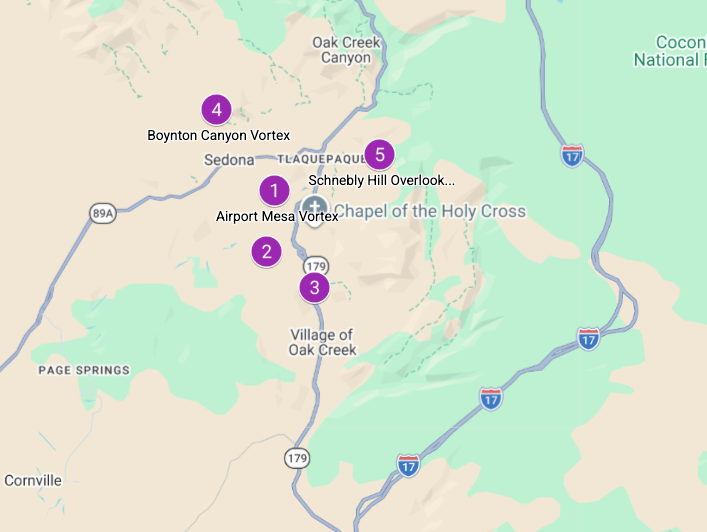
Check out this map of Sedona Vortexes below: