Wellness and Night Experiences | Sedona’s Best
By Sedona’s Best | Wellness and Night Experiences | Updated 2026
Quick Answer
Star bathing is a wellness practice of lying or meditating under a dark, open night sky to decompress, reconnect, and absorb the restorative calm of natural darkness. Sedona, Arizona is a certified International Dark Sky Community that is ranked among the best places in the U.S. to experience it, thanks to its nearly 300 clear nights per year, high-desert elevation, and 9 designated dark sky viewing areas.
Best spots: Airport Mesa, Fay Canyon, Two Trees Observation Area, Aerie Trailhead, Beaverhead Flat Scenic Overlook, and more.
Looking for the Best Viewing Locations?
Explore Sedona’s complete Stargazing Guide with maps, directions, and Sedona’s top dark sky viewing areas.
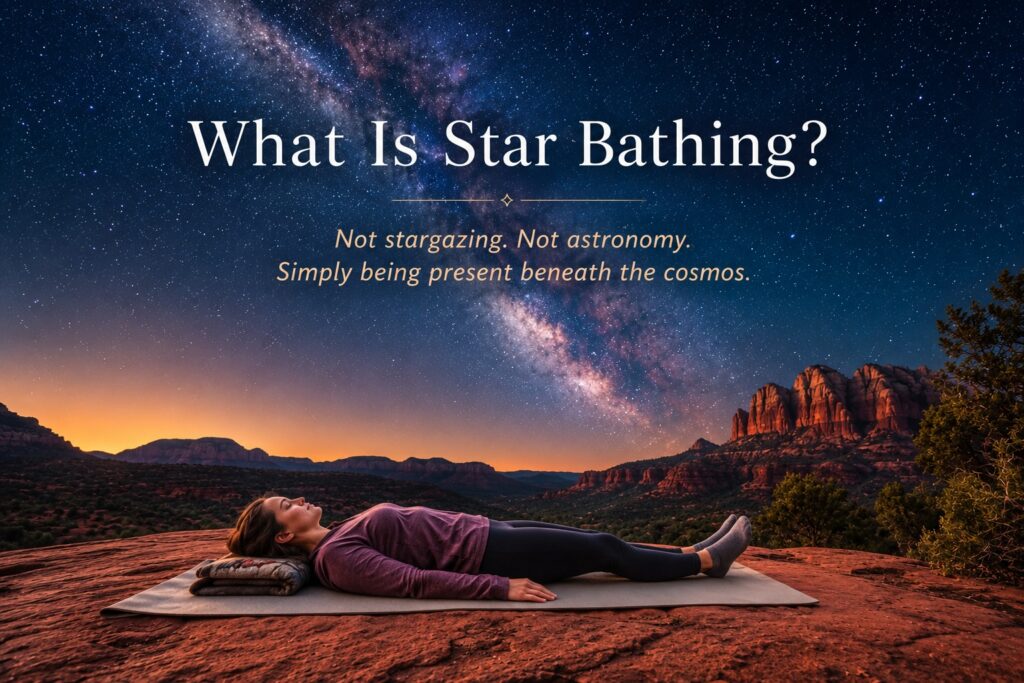
Imagine lying on a warm desert boulder as the last of Sedona’s red rock silhouettes fade into an ink-black sky. Above you, unbothered by city lights, the Milky Way blazes edge to edge. This is star bathing in Sedona, and it just might be the most quietly transformative wellness experience you have not tried yet.
Parade magazine recently named star bathing one of the hottest emerging wellness trends. Sedona is not just a participant in this trend. It is the destination that defines it.
What Is Star Bathing? (And Why It Is Not Just Stargazing)
Star bathing is the intentional practice of spending time outdoors at night under a dark, open sky, not to observe or identify celestial objects, but to simply be present beneath them. Think of it as the nocturnal counterpart to forest bathing (Shinrin-yoku): the goal is immersive stillness, not astronomy.
Unlike traditional stargazing, star bathing prioritizes the felt experience over the intellectual one. Practitioners lie flat, breathe slowly, and allow the vastness of the night sky to create what researchers call an awe response, a measurable shift in perception that reduces cortisol, increases feelings of connectedness, and quiets the nervous system.
The science backs it up. Studies show that exposure to natural darkness regulates melatonin production, supports circadian rhythms, and reduces stress markers. The practice is increasingly being incorporated into wellness retreats, spa programs, and guided meditation experiences across the country, and Sedona is leading the way.
Why Sedona Is the Best Place in Arizona to Star Bathe
Certified International Dark Sky Community
Sedona holds one of the most prestigious designations in nighttime sky preservation: certified International Dark Sky Community status, awarded by the International Dark-Sky Association (IDA). This is not a marketing label. It requires the entire community to adopt strict outdoor lighting ordinances, reduce artificial sky glow, and actively protect the quality of the night sky for residents and visitors alike.
The result is a night sky that is measurably, consistently dark. Light pollution is controlled by law. The stars you see in Sedona are the same stars that early desert civilizations navigated by, and that is not an accident.
Ideal Natural Conditions
Beyond its certification, Sedona’s geography works in your favor: high desert elevation (4,350 feet), low humidity, minimal cloud cover, and nearly 300 clear nights per year. The Milky Way is visible to the naked eye. Shooting stars are routine. And the canyon-deep silence of the red rock country makes the experience feel almost ceremonial.
9 Official Star Bathing and Stargazing Spots in Sedona
Sedona’s Best has mapped nine designated dark sky viewing areas across the region, from hidden canyon floors to wide-open desert overlooks. Here is your complete guide:
1. Aerie Trailhead
Location: End of Boynton Pass Road, near Boynton Canyon. One of Sedona’s most remote access points for pure night sky viewing. The trailhead sits at the mouth of Boynton Canyon, a vortex site by day and a star bather’s sanctuary by night. The canyon walls frame a corridor of sky that eliminates peripheral light. Best for: Meditation, solitude, and uninterrupted Milky Way views.
2. Baldwin Trailhead
A quiet, lesser-trafficked trail near Oak Creek with sweeping views of Cathedral Rock, one of Sedona’s most iconic formations. Cathedral Rock’s silhouette against a star-filled sky is among the most photographed night sky compositions in Arizona. Best for: Landscape astrophotography and serene star bathing with a landmark anchor.
3. Beaverhead Flat Scenic Overlook
Location: Schnebly Hill Road (high elevation). This elevated overlook on Schnebly Hill Road rewards the drive with one of the widest unobstructed sky views in the region. Higher elevation means reduced atmospheric interference and a notably darker horizon. Best for: Panoramic sky immersion and groups seeking a designated pullout.
4. Dry Creek Road
Remote pullouts along Dry Creek Road offer some of the darkest skies accessible by car in the Sedona area. This is a local favorite that is far enough from downtown to eliminate ambient glow but easy to reach. Best for: First timers who want very dark skies without a significant hike.
5. Fay Canyon
Fay Canyon is one of Sedona’s best-kept dark sky secrets. The canyon’s natural walls block ambient light from surrounding areas, creating an enclosed corridor of exceptionally dark sky. Combine it with the canyon’s resident silence, no road noise and no foot traffic at night, and you have one of the most meditative star-bathing environments in all of Red Rock Country. Best for: Deep relaxation, sound meditation, and total sensory stillness.
6. Jordan Park
Location: Northeast Sedona. Jordan Park benefits from surrounding cliff formations that naturally shield it from light pollution, making it a reliably dark viewing area accessible from residential Sedona. It is a favorite among local astronomers for casual observing sessions. Best for: Community events, beginners, and visitors staying in Uptown Sedona.
7. Merry Go Round Rock
This distinctive red rock formation near the Schnebly Hill area offers wide-open sky access with minimal obstruction. The flat terrain around the formation gives star bathers room to spread out fully under the dome of the night sky. Best for: Lying flat, full-sky immersion, and long meditation sessions.
8. Sedona Cultural Park
Location: West Sedona. The Cultural Park is one of the most accessible dark sky sites in Sedona, with no hiking required, easy parking, and a large open area for groups. It hosts periodic astronomy events and is a popular destination for families and first-time stargazers. Best for: Beginners, families, and organized group stargazing events.
9. Two Trees Observation Area
A wide-open desert sky popular with Sedona’s astronomy community, Two Trees is known for offering exceptional horizon-to-horizon views with minimal light interference. It is a go-to spot for serious stargazers who bring telescopes, but its openness also makes it ideal for the passive, restorative practice of star bathing. Best for: Astronomy enthusiasts and experienced star bathers seeking expansive sky access.
Guided Star Bathing and Astronomy Experiences in Sedona
For visitors who want to go deeper than a blanket and an open sky, Sedona offers curated night sky experiences that blend astronomy with wellness:
Guided Astronomy Tours
Local astronomy guides lead small-group evening tours to designated dark sky sites, equipped with professional telescopes and deep knowledge of Sedona’s celestial calendar. Expect constellation storytelling, views of Jupiter’s moons, and narration that connects the night sky to Sedona’s cultural and Indigenous history.
Nighttime Astronomy and Spa Retreats
Several of Sedona’s luxury resorts and wellness centers have incorporated the night sky into their spa programming. Think rooftop star bathing sessions followed by sound baths, moonlit yoga under the desert sky, or guided nighttime meditations set against the red rocks. These immersive retreats are wellness travel at its most elevated.
Vortex and Night Sky Combinations
Several of Sedona’s most powerful energy vortex sites, including Boynton Canyon (adjacent to the Aerie Trailhead) and Airport Mesa, are also premier stargazing locations. Guided tours that combine vortex energy work with nighttime sky meditation offer a distinctly Sedona experience found nowhere else in the world.
Star Bathing Tips for First Timers in Sedona
Time it with the new moon. The new moon phase produces the darkest skies. Check a lunar calendar before your trip. The difference between a full moon and a new moon night is the difference between seeing a hundred stars and seeing ten thousand.
Layer up, even in summer. Sedona’s desert temperatures drop 25 to 30 degrees F after sunset. Bring layers regardless of the season. A blanket is essential for lying flat and staying warm enough to fully relax.
Allow 20 to 30 minutes for night vision. Your eyes adapt to darkness gradually. Avoid your phone screen entirely. Even a brief glance resets your adaptation. Use a red-light flashlight if you need to navigate.
Lie completely flat. A yoga mat or sleeping pad on the ground gives you the full 180 degree dome of sky in your field of vision. This is the difference between looking at the sky and being inside it.
Use the Sedona’s Best Stargazing Guide. All 9 official viewing sites are mapped with GPS coordinates for easy navigation. Find the full guide at https://sedonabest.com/best-sites-for-stargazing-in-sedona-az/.
Frequently Asked Questions: Star Bathing in Sedona
What is star bathing?
Star bathing is a wellness practice that involves lying or meditating outdoors under a dark night sky. Unlike traditional stargazing, the focus is on relaxation and presence rather than identifying celestial objects. It is similar in philosophy to forest bathing (Shinrin-yoku) but practiced at night under the open sky.
Is Sedona a good place for stargazing?
Yes. Sedona is one of the best stargazing destinations in the United States. It holds official International Dark Sky Community certification, has nearly 300 clear nights per year, and maintains 9 designated dark sky viewing locations across the region.
What is the best stargazing spot in Sedona?
According to Sedona’s Best Stargazing Guide, top spots include Fay Canyon for exceptional darkness, Two Trees Observation Area for wide open sky, Beaverhead Flat Scenic Overlook for elevation and panoramic views, and Aerie Trailhead for solitude near Boynton Canyon.
Is Sedona a certified International Dark Sky Community?
Yes. Sedona, Arizona is officially certified by the International Dark-Sky Association (IDA) as an International Dark Sky Community, which requires strict outdoor lighting standards and active protection of the night sky from light pollution.
When is the best time to go star bathing in Sedona?
The best time for star bathing in Sedona is during the new moon phase, when the moon does not illuminate the sky, on clear nights between March and October. The summer monsoon season, July through August, can bring clouds but also produce dramatic lightning and post-storm clarity.
Are there guided stargazing tours in Sedona?
Yes. Sedona offers guided astronomy tours, nighttime vortex experiences, and spa retreats that incorporate star bathing into their programming. These range from small-group telescope tours to immersive resort retreats combining sound baths, yoga, and meditation under the night sky.
Do I need any equipment for star bathing in Sedona?
No equipment is required. A blanket or yoga mat, warm layers, and a red-light flashlight are all you need for a star bathing session. A telescope or binoculars can enhance the experience, but are not necessary for the practice itself.
Star bathing will not give you a tan. But the research on awe, mindfulness, and the restorative power of natural environments suggests it might do something more valuable: leave you feeling genuinely, quietly restored. Sedona, with its certified dark skies, nine mapped viewing sites, and centuries of connection to the cosmos, offers the most compelling setting in the American Southwest to find out for yourself.
The sky is waiting. Pick a spot. Lie flat. Look up.
Plan Your Sedona Night Sky Experience
View the complete Sedona’s Best Stargazing Guide and Interactive Map.
Sources and References
- Parade - This Nighttime Experience Is Becoming a Popular Wellness Trend
- Sedona’s Best Stargazing Guide and Map
- International Dark-Sky Association - Sedona, AZ (IDA Certified Community)
Keep exploring: best hikes in Sedona · Sedona, Arizona guide